
The Quiet Erosion of Innocence in Nigerian Childhood
- Home
- Blog

By Omolola Olakunri
A few weeks ago, a Nigerian mother sounded an alarm on social media. Her five-year-old’s school textbook contained a story of a dog stealing meat, and having its skin seared with fire as punishment.
Her concern was simple and immediate: what exactly are we teaching our children, and at what cost?
Worrying that the child might imitate or be desensitized by such an action.
The State Government moved quickly to distance itself, stating the book was not part of the approved curriculum.
But the real issue goes far beyond one textbook. It forces a more uncomfortable question, one many would rather avoid.
Who is shaping the minds of Nigerian children today?
There was a time when childhood in Nigeria had a certain rhythm and innocence. Evenings were for Tales by Moonlight. Stories rich in culture, caution, and clarity. Television offered programs like Cockcrow at Dawn, where lessons were layered but never inappropriate for the young mind.
Imported content that included Sesame Street, Tom and Jerry.. Zoltron, defender of the Universe were in line with these principles of preserving innocence.
These stories did not confuse childhood with adulthood. They were entertaining and educational. Today, that boundary is fading.
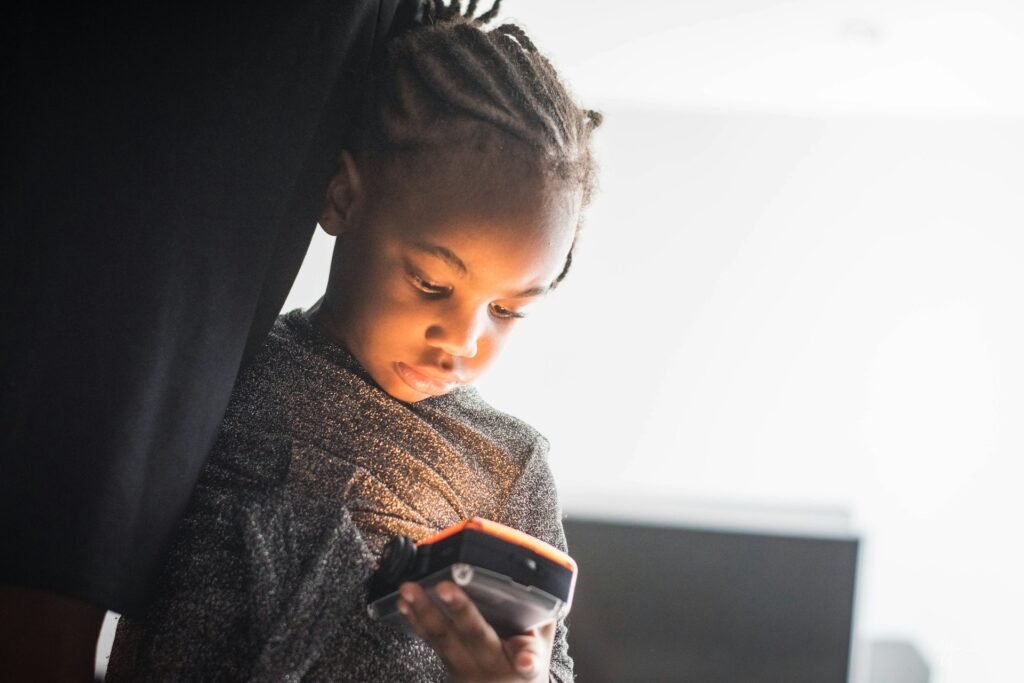
We like to comfort ourselves with the idea that “Nigeria is still conservative,” that adult content does not easily reach children. That assumption is no longer true. The average Nigerian child now holds in their hands a device more powerful than any television their parents grew up with. Through platforms like YouTube and TikTok, they are only a few taps away from content never designed for their age.
Unfiltered, uncensored, and often unquestioned.
And it is not just overtly explicit material like Pornography that should concern us, there is a subtler shift taking place. Children’s content books, cartoons, and programs are becoming increasingly layered with themes that blur the line between what is age-appropriate and what is not.
This includes humor meant for adults, relationships introduced too early, and ideas presented without the maturity required to process them.
An example of this is Disney, a company synonymous with children. and one that is a destination mecca for kids and early teens. In 2022, it produced a film called Light Years, which featured two women kissing. It was labelled not ‘child friendly’, ‘Coming for the children’, and a form of ‘grooming’.
Disney kept the kissing scene. Preferring instead to take the hit.
It was banned in fourteen countries.
Again, in the same year, Disney came out with Strange World. An animated film whose main character is an openly gay teenager.
Backlash from conservative groups complained it was ‘sexualizing children.’ It bombed at the box office.
Individually, these may seem harmless. Collectively, they signal something more troubling: a gradual normalization of premature exposure, while the mind is still too young to grasp true intentions.
Let’s be clear, this is not about resisting change or denying that the world is evolving. It is about asking whether children must absorb all of that change at once, without guidance, without filters, and without restraint.
This is because when everything is accessible, nothing is moderated.
And when nothing is moderated, childhood itself begins to shift quietly, almost invisibly.
What makes this even more concerning is the growing absence of supervision.
Devices have become digital babysitters. Silence has replaced conversation. Convenience has replaced caution.
But no algorithm will raise a child with values. No platform will decide what is appropriate for your five-year-old with the same care you would.
If parents step back, other voices will step in.
This is not alarmism; it is reality.
The responsibility, uncomfortable as it may be, rests squarely on the home. Not in the form of total restriction, but in deliberate involvement. Knowing what your child watches. Asking questions. Setting boundaries. Explaining what they do not yet understand.
Because exposure without guidance is not education, it is confusion.
Nigeria does not have to lose the essence of its childhood. But preserving it will require more than nostalgia. It will require attention, intention, and, above all, responsibility.
The world is louder now. The influences are stronger. The access is wider.
If we do not actively shape what reaches our children, something else will.
And it may not share our values.
Subscribe
Login
0 Comments
Oldest
Newest
Most Voted
About Us
Write Affairsu00a0was created in June 2024 as an extension ofu00a0Quintessential Strategies Limited (QSL) to meet the growing demand for expert writing services.